
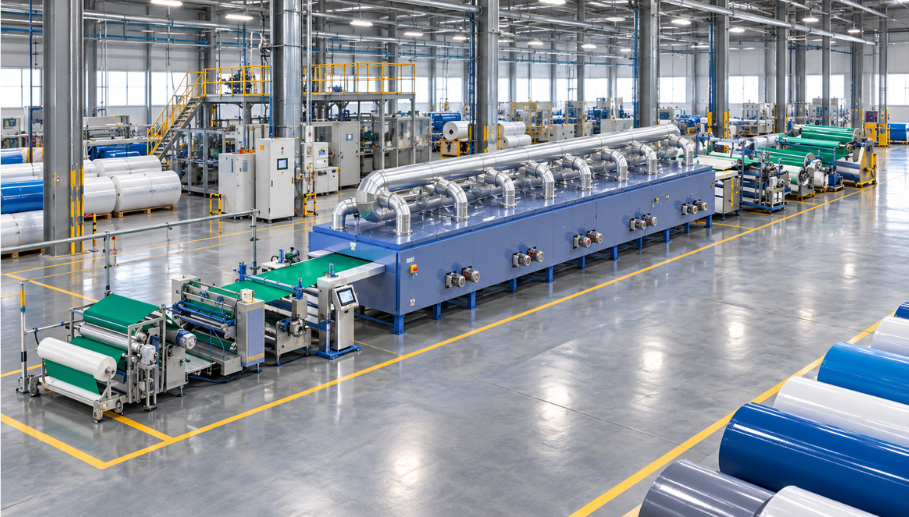
Coating Stenter: How It Improves Textile Coating, Drying and Finishing
In textile manufacturing, achieving a consistent coated fabric requires more than simply applying a coating material to the fabric surface. The coating must be distributed uniformly, followed by controlled drying or curing under suitable processing conditions.
A coating stenter combines coating and controlled heat treatment in a continuous textile processing operation. It can help manufacturers manage coating application, drying, heat distribution, fabric handling, and output consistency within an integrated production process.
Shakti Textile Engineers manufactures Coating Stenters designed for continuous fabric coating and drying. According to the company’s product information, its machine is suitable for cotton, synthetic, and technical fabrics and incorporates an integrated coating system, controlled heat drying, uniform airflow distribution, and multi-chamber industrial construction.
What Is a Coating Stenter?
A coating stenter is a textile processing machine used for applying coatings and drying fabrics in a continuous process.
Unlike a standalone coating operation where coating application and subsequent processing may be handled separately, a coating stenter integrates coating with controlled heat treatment.
The process is designed to help achieve:
- Uniform coating application
- Controlled drying
- Consistent heat distribution
- Controlled fabric processing
- Consistent fabric output
- Continuous production
The exact machine configuration depends on the fabric, coating material, production requirements, and desired finished-fabric characteristics.
How Does a Coating Stenter Work?
The working principle of a coating stenter involves controlled fabric movement through different processing stages.
Fabric Feeding
The textile fabric enters the machine and is guided through the processing line.
Consistent fabric movement is important because variations in fabric tension or handling can influence the coating and finishing process.
Coating Application
The coating material is applied to the fabric using the integrated coating system.
The objective is to distribute the coating across the required fabric width with controlled thickness and consistency.
The appropriate coating method depends on the material being applied and the characteristics of the fabric substrate.
Controlled Heat Treatment
After coating application, the fabric moves through heated sections of the machine.
The coating stenter uses controlled heat to support the required drying or curing conditions.
Shakti Textile Engineers specifies direct or indirect heating options for its coating stenter, depending on the machine configuration.
Airflow and Drying
Uniform airflow is an important part of the drying process.
If different sections of the fabric receive significantly different drying conditions, variations in the final coating may occur.
The coating stenter is designed with uniform airflow distribution to support consistent drying across the fabric.
Fabric Output
After the required processing stages, the fabric exits the machine for subsequent operations such as cooling, inspection, winding, embossing, laminating, or other finishing processes depending on the production line.
Why Is Controlled Drying Important in Textile Coating?
Drying is a critical stage in many coating processes.
Once a coating material has been applied, it needs to undergo the appropriate thermal or drying conditions to achieve the desired processed state.
Poorly controlled drying can contribute to process inconsistency.
Important variables can include:
- Temperature
- Airflow
- Fabric speed
- Fabric tension
- Dwell time
- Coating characteristics
- Fabric construction
The exact processing conditions should be established according to the coating formulation and fabric being processed.
A coating stenter provides a controlled environment in which these variables can be managed as part of a continuous process.
Role of Heat Distribution in a Coating Stenter
Uniform heat distribution is important when processing coated fabrics.
A fabric web may be relatively wide, so differences in heating conditions across the width can affect the drying process.
A properly designed system should therefore provide controlled heat distribution across the processing area.
Shakti’s Coating Stenter is described as incorporating precise heat distribution and controlled heat drying to support consistent processing.
Coating Stenter vs Conventional Drying Equipment
A coating stenter is specifically designed to integrate coating and drying within a continuous textile process.
Factor | Coating Stenter | Standalone Drying Equipment |
Coating application | Integrated into the process | May require separate equipment |
Drying | Controlled within the coating line | Primarily focused on drying |
Heat control | Designed for coating and drying requirements | Depends on equipment configuration |
Fabric processing | Continuous | Depends on production setup |
Integration | Can form part of a larger coating line | May require additional equipment |
Application | Coating and finishing | Primarily drying or heat treatment |
The choice depends on the production process and whether the manufacturer requires an integrated coating and drying solution.
What Fabrics Can Be Processed?
The suitability of a coating stenter depends on the machine configuration and production requirements.
Shakti Textile Engineers lists the following fabric categories for its Coating Stenter:
- – Cotton
- – Synthetic fabrics
- – Technical fabrics
The company positions the machine for applications requiring coated fabrics, including automotive, apparel, and technical textile production.
Before purchasing equipment, manufacturers should discuss their actual fabric specifications with the machinery supplier.
Applications of Coating Stenters
Coating stenters can be used across different textile manufacturing applications where fabric coating and controlled drying are required.
Technical Textiles
Technical fabrics can require controlled coating processes to achieve application-specific functional characteristics.
A coating stenter can provide a continuous processing route for applying and drying suitable coating materials.
Automotive Textiles
Coated fabrics are used in various automotive-related textile applications.
The required coating material, fabric construction, and finishing characteristics depend on the specific application.
Apparel Textiles
Coating processes can also be used on selected apparel fabrics when particular surface or functional characteristics are required.
Industrial Fabrics
Industrial textile applications can require consistent coating and controlled drying for specific product requirements.
The final suitability depends on the fabric, coating formulation, process parameters, and intended application.
Key Features to Consider When Choosing a Coating Stenter
Manufacturers should evaluate a coating stenter based on the complete production process rather than considering only machine speed.
1. Integrated Coating System
The coating system should provide controlled and uniform application across the required fabric width.
An integrated system can help streamline the coating and drying sequence.
2. Heat Control
The heating system should provide appropriate and controllable conditions for the coating process.
Different coating formulations can have different drying or curing requirements, so the heating arrangement should be evaluated accordingly.
3. Uniform Airflow
Airflow plays an important role in drying.
A suitable airflow system should support consistent drying conditions across the fabric width.
4. Fabric Compatibility
The machine should be evaluated against the actual fabric types that will be processed.
Fabric weight, width, construction, coating material, and process requirements can all influence machine selection.
5. Processing Speed
Production speed should be considered alongside coating quality.
A higher line speed is useful only when the coating and drying process can maintain the required product specifications at that speed.
6. Control System
Shakti lists automatic and manual control configurations for its Coating Stenter.
The appropriate control arrangement depends on the manufacturer’s production requirements and desired level of process automation.
7. Machine Configuration
The overall machine configuration should correspond to the required processing stages.
Shakti describes its Coating Stenter as having a multi-chamber industrial structure.
8. Maintenance and Accessibility
Maintenance requirements should also be considered before selecting machinery.
Easy access to relevant machine components can help support routine maintenance and reduce unnecessary production interruptions.
Factors That Affect Coating Quality
A coating stenter is only one part of the overall coating process. Final fabric quality can be influenced by multiple factors.
Coating Material
The formulation and viscosity of the coating material can affect application behaviour.
Fabric Surface
The construction and surface condition of the fabric can influence coating uniformity.
Coating Thickness
The required coating thickness needs to be controlled according to the final product specification.
Fabric Speed
The processing speed affects the time available for drying or curing.
Temperature
The appropriate temperature depends on the coating material and fabric.
Airflow
Consistent airflow helps provide more uniform drying conditions.
Fabric Tension
Improper tension can affect fabric handling and dimensional behaviour during processing.
For this reason, machinery selection should be considered together with the complete coating process.
Coating Stenter and PVC / PU Coating
A coating stenter can form part of a production line using polymer coating materials such as PVC and PU.
Shakti Textile Engineers also manufactures PVC / PU Coating Machines designed for applying polymer coatings onto fabrics with controlled coating thickness and uniform drying.
The specific machinery arrangement depends on the required coating method and production configuration.
For manufacturers considering PVC or PU coating, factors such as:
- Coating formulation
- Fabric substrate
- Required coating thickness
- Production speed
- Heating requirements
- Drying conditions
- Final fabric application
should be considered before selecting the machinery.
Integrating a Coating Stenter With Other Textile Machinery
A coating stenter can be connected with other textile processing equipment depending on the production line.
Potential supporting machinery can include:
- Cooling drums
- Fabric edge trimmers
- Fabric edge trimmers
- Cloth winders
- Printing units
- Inspection machines
- Laminating machines
Shakti Textile Engineers’ coating machinery range includes equipment such as cooling drums, fabric edge trimmers, embossing heads, fabric winders, printing units, inspection machines, and laminating equipment.
Considering these processes together can help manufacturers plan a more coordinated production line.
Coating Stenter for Continuous Textile Processing
Continuous processing can be important for manufacturers operating at industrial production volumes.
A coating stenter can combine coating application and controlled drying in a continuous sequence, reducing the need to treat these processes as completely separate operations.
Shakti specifies continuous processing for its Coating Stenter and highlights high-speed operation as one of its machine features.
However, the practical production speed should always be determined according to the actual fabric, coating formulation, drying requirements, and product specifications.
How to Select the Right Coating Stenter
Before investing in a coating stenter, textile manufacturers should prepare a clear set of production requirements.
Define the Fabric Range
Identify:
- Fabric type
- Fabric width
- Fabric weight
- Fabric construction
- Expected production range
Define the Coating Requirements
Specify:
- Coating material
- Required coating thickness
- One-side or other application requirements
- Drying or curing conditions
- Desired surface finish
Define Production Capacity
Determine the required output and expected operating conditions.
The machine should be selected based on achievable process requirements rather than speed alone.
Evaluate Heating Requirements
Discuss the appropriate heating arrangement with the machine manufacturer.
Shakti lists direct and indirect heating configurations for its Coating Stenter.
Consider Future Requirements
If the manufacturer expects to process additional fabric types or coating materials in the future, the machine configuration should be evaluated for the anticipated production range.
Coating Stenter From Shakti Textile Engineers
Shakti Textile Engineers offers a Coating Stenter designed for continuous fabric coating and drying applications.
According to the company’s product information, the machine includes:
- – Integrated coating system
- – Controlled heat drying
- – Uniform airflow distribution
- – High-speed operation
- – Multi-fabric compatibility
- – Automatic or manual control options
- – Direct or indirect heating options
- – Multi-chamber industrial construction
The company states that the machine is intended for cotton, synthetic, and technical fabrics and applications including automotive, apparel, and technical textiles.
For textile manufacturers evaluating coating and finishing equipment, the final machine configuration should be discussed according to the fabric range, coating material, production capacity, drying requirements, and downstream processes.
Frequently Asked Questions
What is a coating stenter?
A coating stenter is a textile processing machine designed to combine coating application with controlled drying or heat treatment in a continuous process.
What is the purpose of a coating stenter?
Its primary purpose is to support uniform coating application and controlled drying of textile fabrics during continuous processing.
Which fabrics can be processed using a coating stenter?
Shakti Textile Engineers lists cotton, synthetic, and technical fabrics as suitable fabric categories for its Coating Stenter.
Why is airflow important in a coating stenter?
Uniform airflow helps maintain consistent drying conditions across the fabric width, which can support more consistent processing.
What heating systems are available?
Shakti’s Coating Stenter product information lists direct and indirect heating options.
Can a coating stenter be used for technical textiles?
Yes. Shakti specifically lists technical fabrics among the fabric types and technical textiles among the intended application areas.
What should I consider before buying a coating stenter?
Important considerations include fabric type and width, coating material, coating thickness, required production capacity, drying requirements, heating system, control configuration, and integration with other machinery.
Does Shakti Textile Engineers manufacture coating stenters?
Yes. Shakti Textile Engineers lists a Coating Stenter as part of its textile machinery range for fabric coating and drying.
Conclusion
A coating stenter can play an important role in continuous textile coating and finishing by integrating coating application with controlled drying and heat treatment.
Uniform coating, controlled airflow, appropriate heating, fabric handling, and process speed all contribute to consistent production. The right machine configuration ultimately depends on the fabric, coating formulation, production requirements, and downstream processes.
Shakti Textile Engineers provides Coating Stenters for cotton, synthetic, and technical fabrics, along with related coating, cooling, inspection, laminating, and fabric-handling machinery.