
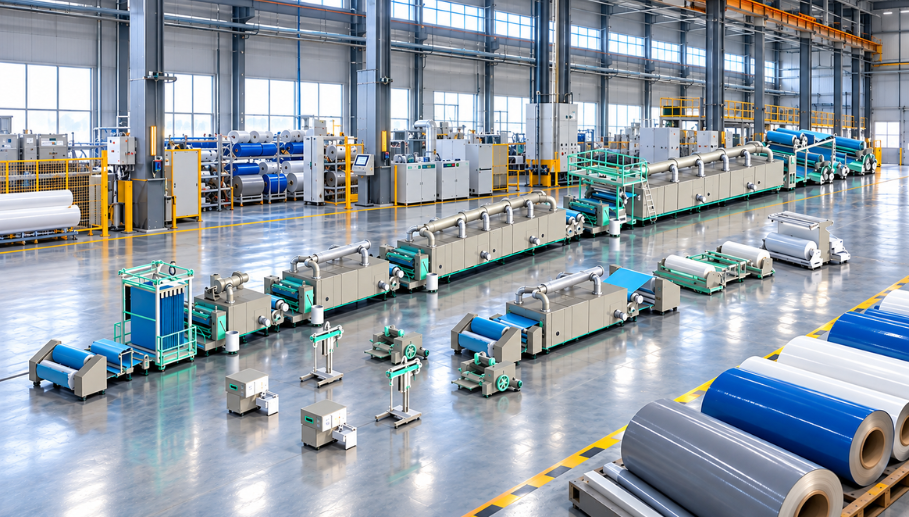
PVC & PU Coating Machines: Working, Applications and Key Selection Factors
In textile manufacturing, coating is used to add specific functional or surface properties to fabrics. Depending on the application, polymer coatings such as PVC (Polyvinyl Chloride) and PU (Polyurethane) can be applied to textile substrates to improve durability, surface characteristics, and functional performance.
For manufacturers working with coated textiles, selecting the right PVC PU coating machine is an important production decision. The machine needs to provide controlled coating application, consistent thickness, suitable processing speed, and effective drying or curing conditions.
Shakti Textile Engineers manufactures PVC / PU Coating Machines designed for continuous fabric coating and finishing applications. The machine is described by the company as suitable for technical and industrial textiles and supports PVC, PU, and similar polymer coatings.
What Is a PVC PU Coating Machine?
A PVC PU coating machine is textile processing equipment designed to apply polymer coatings such as PVC or PU onto fabric surfaces in a controlled and continuous process.
The coating can be used to modify the surface and functional characteristics of the fabric according to the intended application.
A properly designed coating line can help manufacturers maintain:
- Uniform coating application
- Controlled coating thickness
- Consistent fabric processing
- Controlled drying or curing
- Smooth surface finish
- Efficient continuous production
- Compatibility with different textile substrates
Shakti Textile Engineers’ PVC / PU Coating Machine is designed for fabric coating and finishing and incorporates adjustable thickness control, high-speed processing, uniform drying, and compatibility with various textile materials.
Why Is PVC and PU Coating Used on Fabrics?
Different textile applications require different surface and performance characteristics.
PVC and PU coatings can be used when manufacturers need to add functional properties to a textile substrate.
Depending on the formulation and application, coated fabrics may be used in areas such as:
- Automotive interiors
- Upholstery
- Protective clothing
- Technical textiles
The suitability of a particular coating depends on the fabric substrate, formulation, required coating properties, production process, and final application.
How Does a PVC PU Coating Machine Work?
The exact configuration can vary depending on the coating process and production requirements. A continuous coating line generally involves controlled fabric movement, coating application, and subsequent drying or curing.
Fabric Feeding
The textile substrate is introduced into the coating line and guided through the machine.
Controlled fabric movement is important for maintaining consistent processing conditions throughout the fabric width.
Coating Application
The selected PVC, PU, or similar polymer coating is applied to the fabric using the machine's coating system.
The objective is to distribute the coating consistently across the required fabric area.
Thickness Control
Coating thickness is an important process parameter.
The coating system needs to be adjusted according to the required product specification. Shakti's machine includes adjustable thickness control intended to maintain consistent coating levels.
Drying and Curing
After application, the coated fabric requires appropriate drying or curing conditions.
The machine's uniform drying mechanism is designed to support proper processing of the applied coating. Shakti lists thermal, electric, or steam heating options for its PVC / PU Coating Machine.
Fabric Handling and Output
Once the coating has been processed, the fabric continues through the line for subsequent handling, cooling, winding, or downstream processes depending on the production configuration.
Maintaining consistent fabric movement throughout the process can help support uniform production.
PVC Coating vs PU Coating
PVC and PU are different polymer coating materials, and the choice between them depends on the intended textile application.
Factor | PVC Coating | PU Coating |
Material | Polyvinyl Chloride | Polyurethane |
Textile use | Used in various coated and industrial textile applications | Used in various coated and functional textile applications |
Processing | Requires suitable coating and drying/curing conditions | Requires suitable coating and drying/curing conditions |
Machine requirement | Requires controlled coating application | Requires controlled coating application |
Final selection | Depends on required product characteristics | Depends on required product characteristics |
The coating material should be selected based on the fabric, formulation, required properties, production requirements, and final use rather than choosing a material solely on the basis of machine compatibility.
Key Features to Consider in a PVC PU Coating Machine
When evaluating a PVC PU coating machine, manufacturers should consider the complete production requirement rather than focusing on one machine specification.
Case Studies of Innovative Textile Machinery
Shakti Textile Engineering has worked with many textile manufacturers worldwide to implement innovative textile machinery.
1. Coating Thickness Control
Consistent coating thickness is important for maintaining product specifications.
A machine with appropriate thickness adjustment can provide better process control when different coating requirements need to be handled.
2. Coating Uniformity
Uneven application can affect the quality and appearance of coated fabrics.
A suitable coating system should be designed to provide uniform application across the required fabric width.
3. Processing Speed
Production requirements vary between manufacturers.
A coating machine should be selected according to the required production rate, fabric characteristics, coating formulation, and process conditions.
Shakti’s PVC / PU Coating Machine is designed for continuous processing and lists high-speed processing as one of its features.
4. Drying System
Drying and curing are critical stages after coating application.
The heating arrangement should provide suitable and controlled processing conditions for the selected coating material and fabric.
5. Fabric Compatibility
Different textile substrates may require different processing conditions.
The machine should therefore be evaluated against the actual fabrics that will be processed, including their width, construction, weight, and coating requirements.
Shakti states that its PVC / PU Coating Machine is suitable for various textile materials and is intended for technical and industrial textile applications.
6. Continuous Operation
For industrial production, continuous processing can be important for maintaining production flow.
A continuous coating machine can integrate coating, drying, and fabric handling into an organized production sequence.
7. Maintenance and Operation
Machine accessibility, maintenance requirements, control systems, and availability of technical support should also be considered before purchasing equipment.
Shakti describes its PVC / PU Coating Machine as designed for easy operation and maintenance.
Applications of PVC PU Coating Machines
PVC and PU coating technology can be used across several textile and industrial applications.
Automotive Textiles
Coated fabrics can be used in automotive interior applications where specific surface and functional properties are required.
Upholstery
Coated textile materials may be used for upholstery applications where surface finish and durability are important considerations.
Protective Clothing
Certain coated fabrics can be used in protective textile applications, depending on the coating formulation and required performance characteristics.
Industrial Fabrics
PVC and PU coatings are also used in industrial textile applications where the fabric requires specific functional characteristics.
Technical Textiles
Technical textiles can require controlled coating processes for specialized end-use requirements.
Shakti specifically lists automotive interiors, protective clothing, upholstery, and industrial fabrics among applications for its PVC / PU Coating Machine.
How to Choose the Right PVC PU Coating Machine
Before selecting a coating machine, textile manufacturers should define their production requirements clearly.
Identify the Fabric Type
Start by determining which fabrics will be processed.
Consider:
- Cotton
- Synthetic fabrics
- Blended fabrics
- Technical textiles
- Fabric weight
- Fabric width
- Construction and surface characteristics
Define the Coating Material
Determine whether the production process requires PVC, PU, or another compatible polymer coating.
The coating formulation and its processing requirements should be discussed with the machine manufacturer.
Establish Required Coating Thickness
Different products may require different coating thicknesses.
The machine should therefore provide appropriate control over the coating application.
Consider Production Capacity
Production volume and required line speed should be evaluated before selecting the machine configuration.
A machine should be capable of meeting the required production conditions without compromising coating consistency.
Evaluate Drying Requirements
The drying or curing system should be suitable for the coating material and production process.
Heating method, chamber configuration, temperature control, and fabric dwell time can all be relevant considerations.
Consider Future Production Requirements
A machine should ideally be evaluated not only for current production but also for the range of products the manufacturer expects to process in the future.
This can be particularly important for manufacturers producing different fabric types or coated textile products.
Why Coating Uniformity Matters
Uniform coating is one of the most important considerations in textile coating.
Variations in coating thickness can affect the final fabric characteristics and may result in inconsistent product quality.
A controlled coating system helps manufacturers manage variables such as:
- Coating thickness
- Application speed
- Fabric movement
- Drying conditions
- Material distribution
Shakti Textile Engineers highlights uniform coating, adjustable coating-head and roller speeds, and controlled processing among the features of its coating machinery range.
PVC Triple Roll Grinder as Part of PVC Coating Preparation
For PVC-based coating operations, compound preparation can also be an important consideration.
Shakti Textile Engineers offers a PVC Triple Roll Grinder designed for grinding and refining PVC compounds to achieve smooth and uniform consistency. The machine uses three rollers rotating at different speeds to generate shear forces that help break down particles and disperse additives and pigments.
This type of equipment can be relevant where PVC compound preparation is part of the overall coating process.
Integrating Coating With Downstream Processing
A coating machine is often one part of a broader textile production system.
Depending on the product and process, coated fabric may subsequently require operations such as:
- Cooling
- Edge trimming
- Embossing
- Inspection
- Winding
- Printing
- Laminating
Shakti’s coating machinery portfolio includes supporting equipment such as cooling drums, fabric edge trimmers, embossing heads, cloth winders, printing units, inspection equipment, and laminating machines.
Considering these downstream processes during machinery planning can help manufacturers develop a more suitable production line.
Why Work With an Experienced Textile Machinery Manufacturer?
Selecting a coating machine involves more than purchasing individual equipment.
Manufacturers should consider whether the machinery supplier understands:
- Fabric processing requirements
- Coating applications
- Production conditions
- Machine integration
- Process control
- Maintenance requirements
- Technical support
Shakti Textile Engineers states that it has more than six decades of experience in textile machinery and manufactures solutions across textile processing, technical textiles, coating, laminating, inspection, finishing, and related machinery categories.
PVC PU Coating Machines from Shakti Textile Engineers
Shakti Textile Engineers offers PVC / PU Coating Machines for continuous fabric coating and finishing applications.
The machine is designed with features including precision coating, adjustable thickness control, high-speed processing, uniform drying, and compatibility with various textile materials. The company lists thermal, electric, and steam heating options and describes the machine as a heavy-duty industrial design for technical and industrial textile applications.
For manufacturers evaluating a new coating line or upgrading existing textile processing equipment, the appropriate machine configuration should be determined according to fabric characteristics, coating formulation, production capacity, coating thickness, drying requirements, and downstream processing needs.
Frequently Asked Questions
What is a PVC PU coating machine?
A PVC PU coating machine is textile processing equipment used to apply PVC, PU, or similar polymer coatings onto fabric in a controlled process.
What fabrics can be processed using a PVC PU coating machine?
The suitable fabric range depends on the machine configuration and coating process. Shakti Textile Engineers describes its machine as suitable for various textile materials and technical and industrial textile applications.
What is the purpose of coating thickness control?
Thickness control helps maintain a consistent amount of coating on the fabric according to the required production specification.
Why is drying important after coating?
Drying or curing helps process the applied coating under controlled conditions. The required conditions depend on the coating material, fabric, and production process.
What is the difference between PVC and PU coating?
PVC and PU are different polymer materials with different characteristics and processing requirements. The appropriate material depends on the intended textile application and product specifications.
Can PVC and PU coating machines be used for technical textiles?
Yes, coating machinery can be used for technical textile applications when the machine configuration, coating material, fabric, and process requirements are compatible.
What should I consider before buying a coating machine?
Key considerations include fabric type, fabric width, coating material, coating thickness, production capacity, drying requirements, machine configuration, maintenance, and integration with other production equipment.
Does Shakti Textile Engineers manufacture PVC / PU coating machines?
Yes. Shakti Textile Engineers lists a PVC / PU Coating Machine within its coating machinery range for fabric coating and finishing applications.
Conclusion
A PVC PU coating machine plays an important role in producing coated fabrics with controlled and consistent surface characteristics. The right machine configuration depends on several factors, including the coating material, fabric substrate, required coating thickness, production speed, drying conditions, and downstream processing requirements.
For textile manufacturers, evaluating the complete coating process rather than a single machine feature can lead to more practical equipment selection.
Shakti Textile Engineers provides PVC / PU coating machinery for technical and industrial textile applications, along with related coating, inspection, laminating, cooling, and fabric-handling equipment.